Friday, March 7, 2014

Beat The Band Discussion Question #1

Hypothesize what will happen with Cooper's band.

A Poster for a Battle of the Bands Competition
         In the book Beat the Band by Don Calame, Cooper's friends, Matt and Sean, will change their mind about being in a band together and quit before the Battle of the Bands competition. Both Matt and Sean are extremely skeptical of the idea of being in a band together before they even join because they cannot play instruments well. Cooper wants them to join his band so they can win the Battle of the Bands competition to regain Cooper's fleeting popularity. In a conversation with Sean and Cooper, Sean shows his disbelief in the idea of the band."'It's pointless, Coop' Sean says...'We stink. And honestly, I don't see us getting any better in 3 months'"(49). Sean tells Cooper how he thinks that it is useless to even try. He knows they suck and that there is no way they can improve by the time of the competition. Matt and Sean's skepticism towards the band makes me think that they won't want to put in either the time or the energy required to get better and win the competition and they will both drop out. If Matt and Sean leave the band, Cooper will be left alone and won't be able to perform in a battle of the bands competition. With only one person left in the group, he will be forced to forfeit, and will probably gain a bad reputation among his peers.


This Video is From a News Broadcast That Explains a Battle of the Bands competition

Tech Friday#2


Tuesday, February 4, 2014

Glendale District Tuesday Write


       In the Glendale Unified School District, Los Angeles California, the status updates on a large array of social networking sites are being monitored by a company named Geo Listening. Geo Listening reports any school rule violations to the schools to properly deal with issues like cyber bullying, suicide, and drug related issues.
Bullying is just one of many issues that Geo Listening plans to fix.
 I believe that this program could be a great help for some students. A program that can track specific people down when they bully another online sounds great. On the contrary, I also believe that it is unfair that the kids can get in trouble for breaking school rules outside of school. Many students have brought up the fourth amendment to the Constitution, which reads, 
            "The right of the people to be secure in their persons, houses, papers, and effects, against unreasonable searches and seizures, shall not be violated, and no Warrants shall issue, but upon probable cause, supported by Oath or affirmation, and particularly describing the place to be searched, and the persons or things to be seized."
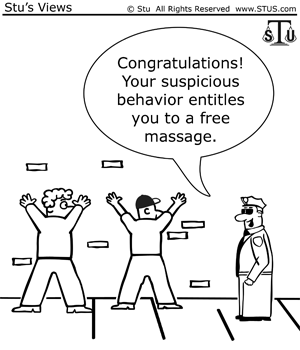
A Comic Depicting the Fourth Amendment
    This makes me unsure of whether I like Geo Listening or not. It seems that students at the Glendale schools have having a tough time deciding as well. Cho, a student at Hoover High said "...It's not the same as being in school, it's student's expression of their own thoughts and feelings to their friends. For the school to intrude in that area- I understand they can do it but I don't think it's right." Cho and his classmates have been watching what they post in fear of the Geo Listening program reporting them to the school administrators.
A group of people monitoring screens. Similar to Geo Listening.
This event reminds me of the book 1984 by George Orwell, where the government is constantly watching over everyone and people learn to live in fear. In both 1984 and real life, people must change their lifestyles to meet the perfect expectations of the higher power.
In this video, two reporters talk about the Glendale District social network monitoring.

Sunday, December 8, 2013

Animal Farm Lit. Circle Reflection

    On Friday, I participated in my first lit. circle since last year. My group was discussing chapter three thorough chapter five of Animal Farm by George Orwell. Since I was absent for the first lit circle, I can't compare the two but I can say that this one went very smooth. Almost everybody had a decent amount of information to contribute and just about every question sparked a debate between at least two members. Even though the majority was contributing during the discussions, there were one or two that weren't adding to the discussions and were off task or spacing out. Next discussion we can improve on this by asking these people more questions that provoke a response and will get them more involved. Overall I thought that this discussion went fine but could definitely be improved on.

Wednesday, October 30, 2013

My Brave Grandpa

I still remember the day my grandpa took me boating for the first time. I was six years old and visiting my Grandpa for the weekend.
  "What do you want to do today?" He asked me.
   "I want to go on the boat!" I yelled as I slammed my Lego tower onto the table.
   "Sounds like a plan!" He told me. A little while later, I found myself on the dock staring at the gigantic lake before me.
   "Watch this." My grandpa said as he picked me up and threw me onto a pile of pillows on the boat. " Oh drat, I can't find my glasses, I'll be right back. Don't touch anything. I trust you to be safe." My grandpa lectured. He walked off towards the direction of the car. Thinking now would be a great time to show him what I knew about boats from my Lego kits, I untied the ropes on the boat and started to float away. I started to panic and yell for my grandpa to help but he was out of earshot and there was no one else around. By the time he got back, I had floated about 20 feet off shore.
  "Don't move Ryan!" My grandpa yelled. "Stay calm!" He grabbed the rope from the water and told me to catch it. I did and held on tight as he pulled us back to shore. After he was sure I was all safe, he scolded me for doing what I had done. I learned my lesson.
Both Ralph and my grandpa show leader like qualities. They are both brave, wise and great at leading. Even though Ralph's ways of leading contrast greatly from my grandpa's.

Wednesday, October 23, 2013

1984 by George Orwell


George Orwell’s “1984:” Big Brother is Watching You
Reviewed by Ryan Bielar

           You arrive home after yet another boring day on the job. The large telescreen watching your every move and listening in on your every sound. One slip up could spell disaster. George Orwell’s “1984” describes perfectly a period in time where the government controls everyone and optimism is against the law.
           “1984” is a political fiction book written by George Orwell (1903-1950) in 1949. The story takes place in London during the year 1984.The story follows Winston, a frail man that works for the government but has little power. The government at this time is oppressive, and takes away almost every freedom that the people have. Winston secretly despises the government, which in his world is a crime that is dealt with harshly. Winston befriends a co-worker named Julia who shares the same feelings about the government. Winston also suspects his boss O'Brien to be a rebel as well. The main antagonist to the trio is a figure only referred to as Big Brother, who is feared by many and seen by few. Although Big Brother is a physical person on all the posters plastered around the city, he is actually just the people of the government. Big Brother consists of the police officers, law makers, and a special type of law enforcers known as the Thought Police that constantly watch and listen to everybody, searching for rebels. Overall, this book does a great job explaining the dangers and problems with an oppressive government.
          One of the major themes of this novel is the loss of the people's freedoms to an oppressive government. Throughout the story, we watch as more and more of the people's freedoms are lost and it makes me realize how trapped these people were. The citizens are in a society in which they cannot speak their feelings, show emotion to anything other than the government, or even generate feelings towards another person. This novel was written at a time in which George Orwell had watched the rise of Adolf Hitler and his influence on the German Government. This made Orwell think about the destructive potential of the government. Orwell wrote, “If you want a picture of the future, imagine a boot stamping on a human face—for ever” (Orwell 215). He knew that if people like Hitler could rise to power, then this powerful government could just as easily do the same. 


         In the story, we see many different ways in which the government attempts to completely control the people. Big Brother used fear to control the actions, speech, and feelings of the citizenry. But the one thing that the government could not control, as much as they want to, was the thoughts of the people. For example, Winston appeared to be a follower of Big Brother’s rules, but internally was rebelling. “Nothing was your own except the few cubic centimeters inside your skull” (Orwell 27). Because of this, you could never get to fully know somebody. Out of fear that anybody could be working with the government, people are forced to keep to themselves, leaving the only place to be an individual inside your thoughts. Orwell showed how important this was by creating a feared organization whose goal was to only control thoughts; The Thought Police.
        The world in “1984” is a place without individuality, a quality that I believe makes life worth living. The way Orwell wrote this story showed me how important these values are in life. If “1984” helped to protect the freedoms we have today, then we all owe George Orwell a great deal of thanks.
Orwell, George. London: Secker and Warburg, 1949. Print

Tuesday, October 15, 2013

Malcolm Gladwell and Subconscious Biases

 I recently read a chapter from Malcom Gladwell's "Blink" called "The Warren Harding Error: Why We Fall For Tall, Dark, and Handsome Men". This chapter was on the subconscious biases or choices that we make without even realizing. What I thought was fairly interesting about this reading was a fact about how fast our brains react. When we have a strong bias, we can usually come up with an association in between four hundred and six hundred milliseconds, but when we don't have that bias, it takes two hundred to three hundred milliseconds longer to come up with an association. I think it is crazy how the brain can actively work that fast at all times. What I think I took away from this chapter was that we are not who we always want to be. Some of these people who took tests found that they were pro-white, even though they might not want to feel that way.


    In leadership, I believe that these subconscious biases may play a part in decisions made, whether they are meant to or not. If somebody in a position of power has a bias towards a certain race or gender, then it will most likely show, even in something small like eye contact or tone of voice. That being said, I believe that these biases can be reversed but not fully eliminated. These thoughts are imprinted in our brains making it very difficult to get rid of them, but learning and practicing to do things right could slow down or even reverse these biases. I believe that someone with very neutral biases would make a great leader because of they're unlikeliness to make decisions based on a person's gender, age, or race.

   After reading chapter three of Malcom Gladwell's "Blink". I took the IAT to see if I had any subconscious biases. My results showed a moderate bias towards whites, and males in the workplace. I was definitely surprised by these results because I totally do not view myself as racist or sexist. We are all one of a kind living on Earth, so the fact that our brain picks people out because of the color of skin or what gender they are and decides that they are less than us is truly strange.